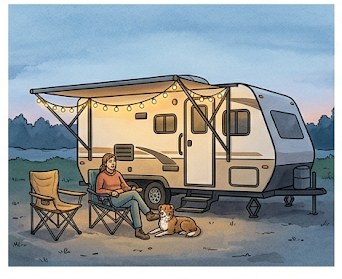
The Couples Assumption — Where It Comes From
The camp hosting world grew up around the assumption of couples. When programs were designed, the math made sense: require 32 hours of volunteer service per week, split between two people, and each person works a manageable 16 hours. The hosting site serves as the couple's home, and both people share the social and physical duties of greeting campers, maintaining the site, and providing campground presence overnight.
Over the past decade, that assumption has shifted — driven partly by demographics (more single retirees, more solo full-time RVers) and partly by practical experience. Rangers have found that one highly committed solo host often outperforms a couple where one partner is reluctant or uninvolved. The trend toward solo-friendly programs is real and continuing.
Programs That Actively Welcome Solo Hosts
State Parks (Generally Most Solo-Friendly)
State park programs have led the shift toward welcoming solo hosts. Several states have explicitly updated their volunteer program materials to include single hosts, and many parks actively recruit singles — particularly for positions in smaller campgrounds where a solo presence is sufficient.
States with strong track records for solo host placements include:
- Oregon State Parks — explicitly welcomes individuals and couples; hour requirements are adjusted for solo hosts (typically 20–24 hours/week vs. 32 for couples)
- Colorado State Parks — solo hosts commonly placed; parks with under 100 sites often prefer one reliable person over a couple who may conflict with staff
- Arizona State Parks — active solo host community; winter desert parks especially well-suited to single hosts
- Minnesota DNR — solo hosts accepted; regional coordinators often helpful in matching singles to appropriate sites
- Michigan DNR — single hosts common in the lower peninsula parks; Upper Peninsula sites tend to prefer couples for heavier-duty positions
Army Corps of Engineers
The COE has historically preferred couples, and at some larger, busier lakes, that preference persists. However, many lake project offices now actively place solo hosts — particularly for:
- Smaller campgrounds where total hosting duties fit within a solo workload
- Non-peak seasons (spring and fall) where traffic is lighter
- Sites where the ranger has a specific, bounded task in mind (fee collection, check-in only)
When applying to COE as a solo host, be direct about your status and ask the ranger to describe the specific duties and weekly hour expectations for the site. Some project offices will adjust the formal volunteer agreement for a solo applicant; others will not budge. Contacting 3–4 lake offices gives you options.
U.S. Forest Service
Forest Service positions vary widely. Larger, developed USFS campgrounds with high visitor traffic can be demanding enough that rangers prefer two people. Smaller, lower-traffic campgrounds in quiet national forests are often ideal for solo hosts and are less competitive to obtain.
The USFS also has a strong tradition of single volunteers through the broader Volunteers-in-National-Forests program, so rangers are accustomed to individual applicants.
Private RV Parks
Private RV parks that hire workampers often have the most flexible arrangements for single hosts. Since it's an employment relationship (not a volunteer agreement), the park sets the terms based on what tasks they need covered. A single workamper who can handle registration desk shifts, grounds maintenance, or activities coordination is a straightforward hire. Many private parks deliberately recruit singles for mid-week shift coverage that couples find harder to staff consistently.
Programs and Situations That Are Harder for Solo Hosts
Honesty matters here. Some situations genuinely favor couples, and going in with clear expectations prevents frustration:
- Large, high-traffic campgrounds: A 300-site lake campground at full capacity on a holiday weekend is a two-person operation. Rangers at these locations are unlikely to accept a solo host for peak season regardless of how persuasive your application is.
- Remote or isolated locations: Some rangers are uncomfortable placing a solo host — particularly a single woman — at a remote campground with no nearby support. This is a safety consideration, not discrimination. Ask directly whether the location has good cell coverage and how close the ranger station is.
- COE lakes with union fee-collection requirements: A small number of COE facilities use contracted employees for fee collection rather than volunteers, which changes the hosting structure entirely.
- Sites with heavy physical maintenance requirements: Positions that include significant physical labor (cleaning vault toilets, moving picnic tables, hauling firewood) are sometimes structured assuming two people sharing that load.
How to Apply as a Solo Host: What to Say and How to Say It
Your application conversation as a solo host needs to answer the ranger's unspoken questions before they become objections:
A strong solo host introduction covers:
- Your RV and self-sufficiency: "I have a fully self-contained [trailer/motorhome], so I'm completely independent for daily living."
- Your experience level: Prior RV experience, outdoor experience, or customer-facing work experience all matter. Mention relevant history.
- Your specific availability: "I'm available [date range] and fully flexible within that window." Flexibility is especially valuable to rangers who struggle to fill gap weeks.
- Your understanding of the workload: "I've read about your program and understand the duties involve [X, Y, Z]. I'm comfortable handling that solo and happy to discuss hour adjustments if needed."
- References if available: A prior park manager, ranger, or even an employer who can speak to your reliability and people skills is worth offering.
Hour Adjustments for Solo Hosts
When a program's formal requirement is 32 hours/week for a couple, what happens when you're solo? The answer varies:
| Program | Typical Solo Hour Adjustment |
|---|---|
| Most state parks | 16–24 hours/week for solo hosts; formally acknowledged in many states |
| COE (project office discretion) | Often 20–24 hours/week; negotiated individually per site |
| USFS | Varies by district; often 20 hours/week at smaller campgrounds |
| NPS (VIP) | Typically 32 hours/week regardless; some flexibility at smaller sites |
| Private RV parks | Set by employer; often 20–30 hours/week for defined shift work |
Safety Considerations for Solo Hosts
This is worth addressing directly because it's a real consideration — especially for women hosting alone.
- ✓ Choose sites with reliable cell coverage — or a campground radio/two-way communication with the ranger station
- ✓ Know the on-call ranger's phone number and the protocol for after-hours incidents before your first night
- ✓ Introduce yourself to neighboring long-term campers early — they become informal community
- ✓ Invest in a basic door alarm or motion sensor for your RV if solo in a remote campground
- ✓ Review the campground's incident protocol — know what you're expected to handle yourself vs. when to call rangers
- ✓ Carry a personal locator beacon (PLB) if hosting at remote wilderness campgrounds
The vast majority of solo hosting seasons pass without any safety incidents. Campgrounds are inherently social environments with constant human presence. But being prepared matters — and rangers are more comfortable placing solo hosts who have clearly thought through these considerations.
The Best First Season Strategy for Solo Hosts
If you're a solo host considering your first season, this approach minimizes friction and maximizes your chances of a great placement:
- Target a smaller campground (under 75 sites) at a state park in a solo-friendly state (Oregon, Colorado, Arizona, Minnesota are good starting points)
- Apply for a shoulder-season position (May–June or September–October) when sites are less competitive and ranger stress is lower
- Be flexible on location — the more geographically flexible you are, the more options you'll have
- Use your first season to build a relationship with a ranger who can serve as a reference for future, more competitive positions
Free Download: First Season Camp Host Checklist
Includes a solo host preparation section with safety checklist, application tips, and gear recommendations specific to single hosts.
Frequently Asked Questions
-
No programs are exclusively for singles, but several state park systems actively market to individual hosts and have adjusted their hour requirements and site assignments accordingly. Oregon, Colorado, and Arizona state parks are frequently mentioned in solo host communities as particularly welcoming. The best way to find solo-friendly positions is to call parks directly and ask whether they've placed solo hosts before and whether the site is suitable for one person.
-
Most solo hosts report the opposite — campgrounds are highly social environments with constant new faces. Your hosting role puts you in contact with dozens or hundreds of visitors per week. The challenge is more often managing social energy than finding enough human contact. That said, evenings and off-days at remote sites can be solitary. Having a good book club, online community, or regular video calls with family helps. Many solo hosts describe their hosting seasons as among the most socially rich periods of their lives.
-
This comes up more than you'd expect — illness, family emergencies, or relationship changes during a hosting season. Notify your ranger immediately and honestly. Most rangers will work with you to adjust the arrangement rather than terminate the agreement, especially if you've established a good working relationship. Some will reduce your required hours; others will ask you to assess honestly whether you can continue. Having the conversation early is always better than struggling alone.
-
Not as a formal policy. Host site assignment is based on availability and rig fit, not applicant household size. In practice, a solo host in a 22-foot trailer might be assigned the same site as a couple in a 42-foot fifth wheel — or might be given a more compact site that works better for their rig. Discuss your RV dimensions during the application process so the ranger can confirm site suitability.
Related Guides
Best States for Camp Hosting
States ranked for program size, solo-friendliness, and hookup quality.
See rankingsHow to Apply for a Host Position
Complete application guide including scripts for your ranger phone call.
Application guideCamp Host Program Finder Tool
Filter programs by solo-friendly status, state, hookup type, and season.
Open toolDisclaimer: Program policies for solo hosts vary by agency, district, and individual park. Always confirm solo host acceptance and hour expectations directly with the specific park or project office you're applying to. This guide reflects general patterns and community experience — not official agency policy.