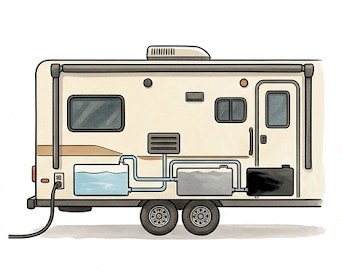
Why Hookup Type Matters So Much for Camp Hosts
For a camper staying three nights, hookup type is a comfort question. For a camp host staying three to six months, it's a lifestyle and budget question. The difference between an electric-only site and a full hookup site affects:
- Water supply: With no water hookup, you're filling your fresh tank from a campground spigot — manageable, but a weekly chore that changes your routine.
- Waste management: Without sewer, you're making regular trips to the dump station. At a busy campground in high season, dump stations can have lines. In winter, tank freezing becomes a real concern.
- Power capacity: 30-amp versus 50-amp electric affects what appliances you can run simultaneously. In summer heat, running an air conditioner on 30-amp while cooking and charging devices requires management.
- Monthly budget: Propane, water hauling, and dump station fees (if not covered by the park) all add up when you're on electric-only for a full season.
Hookup Breakdown by Land Manager
Army Corps of Engineers (COE)
The COE is generally the most hookup-generous federal program, for a practical reason: COE campgrounds were built to serve recreational boaters and family campers at developed reservoir areas, so the infrastructure investment was substantial. Most COE campgrounds have a dedicated host site that was planned as part of the facility design.
| Hookup Type | Frequency at COE Host Sites |
|---|---|
| 50-amp electric + water | Common at newer or recently upgraded facilities |
| 30-amp electric + water | Most common overall configuration |
| Full hookup (E/W/S) | Available at some developed campgrounds; ask specifically |
| 30-amp electric only | Less common; usually at smaller or more rural lakes |
| No hookups | Rare; typically only at primitive areas |
A useful benchmark: if a COE campground has 50-amp sites for paying campers, there's a reasonable chance the host site also has 50-amp. If the campground is all 30-amp, assume the host site is 30-amp.
U.S. Forest Service (USFS)
National Forest hosting is beautiful and often very rewarding — but go in with clear eyes about utilities. Forest Service campgrounds were often built with minimal infrastructure, and host sites reflect that. Electric hookups exist at developed USFS campgrounds, but they're far from universal.
| Hookup Type | Frequency at USFS Host Sites |
|---|---|
| 30-amp electric | Available at developed campgrounds with host sites |
| Electric + water | Less common; exists at some larger developed sites |
| Full hookup | Very rare; a few higher-use USFS campgrounds only |
| No hookups (dry camping) | Common — especially at smaller or dispersed sites |
National Park Service (VIP Program)
NPS host site hookups vary by park type and campground facility level. Developed campgrounds at major parks (Yosemite Valley, Grand Canyon South Rim, Yellowstone) tend to have better infrastructure. Backcountry-adjacent or lesser-visited parks may have minimal utilities for hosts.
| Hookup Type | Frequency at NPS Host Sites |
|---|---|
| 30-amp electric | Common at developed NPS campgrounds |
| 50-amp electric | Present at some high-use parks; not standard |
| Electric + water | Available at better-equipped parks |
| Full hookup | Uncommon; a few parks with modern host sites |
| No hookups | Common at smaller or primitive NPS campgrounds |
State Parks
State park hookup quality is the most variable category because 50 different state systems all do it differently. However, some generalizations hold:
- States that have modernized their campground infrastructure in the last 10 years (Oregon, Washington, Colorado, Minnesota) tend to have better host site hookups.
- States with older campground infrastructure and tighter budgets may have host sites with only electric or even no hookups.
- Popular destination parks within any state tend to have better host site facilities than rural or low-visitation parks.
| State | Typical Host Site Hookups | Notes |
|---|---|---|
| Oregon | Electric + water common; some full hookup | Well-maintained, modern facilities statewide |
| California | Electric common; full hookup at larger parks | Varies significantly by park and region |
| Colorado | Electric + water standard at most parks | Infrastructure upgrades in recent years |
| Minnesota | Electric common; varies by park size | Well-organized program with clear site specs |
| Arizona | Full hookup at many parks | Arizona has invested heavily in host facilities |
| Texas | Electric + water common; full at some | Large variation across 90+ state parks |
| Washington | Electric common; full hookup at select parks | Some coastal parks have limited infrastructure |
| Florida | Full hookup common | Florida State Parks have generally good host facilities |
| Michigan | Electric standard; water + electric at many | Strong program with consistent site quality |
| Tennessee | Electric + water standard | TVA lake parks especially well-equipped |
The Difference Between 30-Amp and 50-Amp for a Full-Season Host
If you're choosing between a 30-amp and 50-amp host site for a 4–6 month stint, the amperage difference is significant for larger rigs. Here's what it means in practice:
- 30-amp (single leg, 120V, max ~3,600W): Runs one air conditioner, a refrigerator, and basic lighting comfortably. Running two ACs simultaneously, a washer/dryer, and an electric water heater can trip the breaker.
- 50-amp (two legs, 240V, max ~12,000W): Handles two air conditioners, washer/dryer, electric water heater, and all other appliances simultaneously without load management.
For rigs under 30 feet or without a washer/dryer, 30-amp is usually adequate. For larger fifth wheels or Class A motorhomes with residential appliances, 50-amp makes a significant quality-of-life difference in summer.
When There Are No Hookups: Dry Camping as a Host
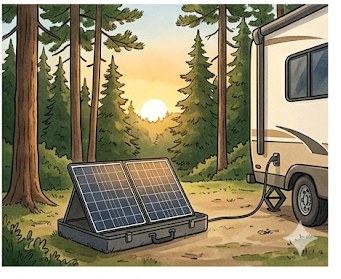
Some genuinely excellent hosting positions — particularly with the Forest Service and at primitive state parks — come with no hookups. This isn't necessarily a dealbreaker if you're prepared. Experienced hosts who dry camp through hosting seasons typically rely on:
- Solar: 400–800W of rooftop panels with lithium battery storage handles most daily needs except air conditioning.
- Generator hours: Most parks allow quiet-hours-compliant generator use for charging. 2–3 hours per day is usually sufficient.
- Propane management: Larger tanks (30–40 lb cylinders) or Manchester/100 lb tanks extend time between fills.
- Water hauling: A 5–7 gallon jug and a campground water spigot is adequate for moderate daily use. Some hosts carry a 50-gallon auxiliary tank.
If you're considering a dry-camp or electric-only host position, a portable solar setup makes a real difference for keeping your fridge, lights, and devices running without relying on generator hours. Many hosts in this situation use a portable solar suitcase like this one — no roof installation needed, and it folds flat for storage when not in use.
As an Amazon Associate, Camp Host Guide earns from qualifying purchases.
Questions to Ask Before Accepting Any Host Position
- ✓ "What is the amperage at the host site — 30 or 50 amp?"
- ✓ "Is water at the site, or from a shared spigot?"
- ✓ "Is sewer at the site, or dump station only?"
- ✓ "Where is the nearest dump station, and is there a charge for hosts to use it?"
- ✓ "Is the host site electric included in the agreement, or do I pay for power used?"
- ✓ "What is the site size — pad length and any overhead clearance issues?"
- ✓ "Is there a generator policy or quiet hours that affect generator use?"
Calculate the Value of Your Host Site Arrangement
Use our free Hookup Value Calculator to see what your site is worth per month — including utilities, site rental equivalent, and effective hourly rate for your volunteer hours.
Frequently Asked Questions
-
At most volunteer programs — state parks, COE, USFS — electricity and water at the host site are included as part of the hosting arrangement. You do not receive a utility bill. At private RV park workamping positions, some parks include all utilities; others credit a set amount toward utilities and you pay overages. Always confirm utility coverage during the application conversation, and get it in writing in your volunteer agreement.
-
This happens occasionally — especially at parks where host site assignments change between seasons. If you arrive and the hookup situation is materially different from what was agreed (e.g., you were told full hookup and arrive to find electric-only), bring it up immediately with the ranger. Document what was discussed during your application. Most rangers will work to resolve genuine discrepancies. This is one more reason to confirm hookup type in writing via email before finalizing your agreement.
-
A single portable or window AC unit (typically 900–1,440W) runs fine on 30-amp alongside typical household loads. The challenge comes when combining it with a built-in roof AC unit, an electric water heater, a microwave, and other high-draw appliances simultaneously. Load management (staggering high-draw items) is a standard skill for 30-amp hosting in summer. If you have a 50-amp rig on a 30-amp site, use a 50-to-30-amp dogbone adapter and be mindful of load.
-
A small number of USFS and BLM hosting positions that require dry camping do offer modest daily stipends ($10–$25/day) partly to offset utility costs. This varies by district and by individual agreement. Ask about stipend availability during your application conversation at any program where hookups are limited or absent.
Related Guides
Hookup Value Calculator
Calculate the true monthly value of your hosting arrangement based on site type, hookups, and hours worked.
Open calculatorCOE Camp Host Guide
The most hookup-generous federal program — how to apply and what to expect.
COE guideSolar Setup for Camp Hosts
How to prepare your rig for electric-only or no-hookup hosting positions.
Solar guideDisclaimer: Hookup availability changes as parks upgrade or modify facilities. Information here reflects general patterns across programs. Always confirm current hookup details directly with the park or project office before accepting a hosting position.