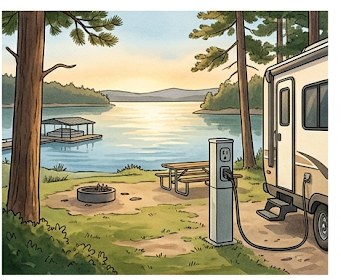
What Is the COE Camp Host Program?
The Army Corps of Engineers manages lakes, rivers, and reservoirs across the country — and the campgrounds that surround them. To staff those campgrounds affordably, the COE runs a robust volunteer program where RVers live on-site in exchange for a set number of weekly service hours.
COE camp hosts are not employees. You're a volunteer, which means no wages, no withholding, and no W-2. What you receive in exchange is a free campsite with hookups, typically at a location that would otherwise cost $30–$55 per night for a regular camper. At the most popular COE lakes during peak summer season, that works out to over $1,400/month in site value alone.
The program is administered district by district, which is the single most important thing to understand about how to apply. There is no single national application system. You apply to individual districts — and sometimes directly to individual lake project offices. This is why searching "COE camp host application" leads most people to volunteer.gov without ever finding the right contact.
How the COE Is Organized (And Why It Matters for Applying)
The Corps of Engineers is divided into eight divisions, which are further broken down into 38 districts. Each district manages the lakes and waterways in its geographic area. When you want to host at a specific lake, you're dealing with that lake's project office, which reports up to the district.
This structure means:
- Hookup types, host site quality, and amenities vary significantly between lakes — even lakes managed by the same district.
- Application timing is set by each project office, not by a national calendar.
- Some lakes fill host positions 6–9 months in advance; others have positions open year-round.
- The best way to find openings is to contact lake project offices directly, not just to search volunteer.gov.
What COE Camp Hosts Actually Do
Duties vary by campground and by the specific arrangement negotiated with the ranger, but common responsibilities include:
- Greeting arriving campers and orienting them to the campground
- Collecting fees or verifying reservations at self-pay stations
- Light maintenance: picking up trash, cleaning fire rings, sweeping pavilions
- Reporting issues to campground staff (downed trees, broken equipment, rule violations)
- Being a visible, approachable presence to deter problems overnight
- Some hosts assist with boat ramp management or swim beach supervision
Most COE volunteer positions call for 32 hours of service per week for couples, or 24 hours per week for solo hosts. This is typically spread across 4–5 days, leaving 2–3 days entirely free. Hours are not usually tracked to the minute — rangers generally want to see you engaged and visible rather than punching a time clock.
What Hookups Do COE Host Sites Get?
This is the most common question and the answer is: it depends on the campground, but COE programs are generally more hookup-generous than other federal programs.
| Hookup Type | COE Availability | Notes |
|---|---|---|
| 30-amp Electric | Very common | Standard at most developed COE campgrounds |
| 50-amp Electric | Common at newer sites | Many COE host sites have been upgraded |
| Water at site | Common | Often included at full-facility campgrounds |
| Full hookup (W/E/S) | Less common but available | Ask specifically when applying to a lake |
| Electric only | Some rural lakes | Water via campground spigot; dump station on-site |
| No hookups | Rare for host sites | Typically at primitive areas only |
When contacting a project office to inquire about hosting, always ask specifically: "What are the hookups at the camp host site?" Don't assume full hookups just because the campground has full hookup sites for paying campers — the host site is sometimes in a separate area with different utilities.
Step-by-Step: How to Apply for a COE Camp Host Position
-
1
Identify Your Target Lakes
Go to recreation.gov and search by region to find COE campgrounds near where you want to host. Make a list of 3–5 specific lakes. The COE's own project finder at corpslakes.erdc.dren.mil lists all managed water projects by state.
-
2
Find the Project Office Contact
Each lake has a project office with a ranger or park manager who oversees volunteers. Search "[lake name] Army Corps of Engineers project office" to find their contact page. Most have a phone number and email. The ranger — not a central HR office — is who you want to reach.
-
3
Call or Email the Project Office Directly
Introduce yourself, mention you're interested in camp hosting, and ask whether they have host openings for your target season. Ask about hookups, site size, duty schedule, and whether they accept solo hosts if applicable. Email is fine, but a phone call gets a faster response and makes you more memorable.
-
4
Create a Volunteer.gov Account (You'll Need It)
Most COE districts process formal volunteer agreements through volunteer.gov. Create a free account. Some districts will ask you to search for and apply to their specific volunteer opportunity listing on the site; others will send you a direct link once they've spoken with you.
-
5
Complete the Volunteer Service Agreement
Once selected, you'll complete a Volunteer Service Agreement (VS-1 form or digital equivalent). This specifies your duties, hours, site assignment, and the dates of service. This is your formal agreement — read it carefully, especially the section on site utilities and any conduct expectations.
-
6
Background Check (Federal Programs Require It)
All COE volunteer hosts undergo a federal background check. This is a standard criminal history check. Most minor or old offenses do not disqualify you. Felony convictions — especially involving theft, violence, or fraud — are more likely to be disqualifying. The ranger will explain the process; it typically takes 2–4 weeks.
-
7
Confirm Site Details and Arrival Date
Before you arrive, confirm in writing: your exact campsite number, hookup type, arrival date, orientation schedule, and who to contact upon arrival. Don't assume — project offices manage multiple sites and multiple volunteers.
Which COE Districts Have the Most Host Openings?
The districts with the most lake projects — and therefore the most hosting opportunities — tend to be in the South and Midwest, where the COE manages major flood control and navigation waterways. The following districts consistently have high volunteer activity:
- Tulsa District (OK, KS, TX) — manages major reservoir recreation areas including Keystone, Eufaula, and Broken Bow lakes.
- Fort Worth District (TX) — manages popular North Texas lakes including Lewisville, Ray Roberts, and Texoma.
- Nashville District (TN, KY) — manages Cumberland River system lakes, popular for extended-stay hosting.
- Savannah District (GA, SC, NC) — Hartwell, Clarks Hill, and Thurmond lakes have active programs.
- Omaha District (NE, SD, ND) — Missouri River reservoirs including Lewis and Clark Lake and Gavins Point.
- Little Rock District (AR) — among the most active COE volunteer programs in the country, known for good ranger-host relationships.
COE Hosting vs. State Park Hosting: Key Differences
| Factor | COE Program | State Park Program |
|---|---|---|
| Application process | Contact project office directly | State-run portal or direct park contact |
| Hookups | Usually electric + water; some full | Varies widely by state and park |
| Hours required | 24–32/week (couple); 16–24 (solo) | Typically 20–40/week; varies by state |
| Background check | Federal check required | State check; varies by state |
| Stay length | Typically 3–6 months per season | 30-day to full-season; varies by park |
| Setting | Usually lakefront, reservoir | Varied: mountains, coast, forest, desert |
| Stipend | Sometimes $10–$25/day | Sometimes; varies significantly by state |
| Solo host friendly | Increasingly yes; ask district | Generally more solo-friendly |
Realistic Timeline: When to Start the Process
For summer positions (May–September) at popular COE lakes: begin contacting project offices no later than January, and ideally October–November of the prior year. Popular lakes with known good host sites (nice full hookup spots, friendly rangers, desirable locations) are spoken for by returning volunteers before any public opening is posted.
For fall and spring positions, a 2–3 month lead time is usually sufficient. Winter hosting positions at Southern lakes (Texas, Arkansas, Tennessee) may be available on shorter notice.
Free Download: First Season Camp Host Checklist
Includes a pre-application checklist, arrival day guide, and end-of-stay protocol. Works for COE, state parks, and USFS programs.
Frequently Asked Questions: COE Camp Hosting
-
No. Most project offices welcome first-time hosts, especially if you can demonstrate reliability (stable contact info, clear arrival/departure dates, references from previous RV park managers or employers). Experienced hosts with prior COE or federal experience will have an edge at the most competitive lakes, but plenty of first-timers are accepted every season.
-
Generally yes, with restrictions. Most COE campgrounds allow leashed pets in the camping areas, and the same typically applies to host sites. Dogs must be kept leashed, vaccinated, and under control at all times. Some rangers have informal size or breed preferences — it's worth mentioning your dog proactively when you apply. See our full pet policy guide for more detail.
-
Life happens, and COE rangers generally understand. Notify your project office as soon as possible. Most Volunteer Service Agreements have a clause about early termination — you're not financially liable, but giving as much notice as possible helps the ranger find a replacement. Hosts who leave abruptly without notice burn bridges and may affect their ability to host at other COE locations.
-
For federal volunteer positions, the IRS generally does not treat the value of a volunteer site as taxable income under the rules for qualified volunteer work. However, if you receive a daily stipend above a certain threshold, that may be reportable. This is a nuanced area — consult a tax professional familiar with workamping and RV lifestyle taxation. See our tax guide for camp hosts.
-
Technically, the Volunteer Service Agreement is signed by the host (or both members of a couple). There's no requirement that both people in a couple work the same hours — some pairs split duties unevenly. However, if only one person in a couple plans to work and the other is essentially a passenger, be transparent about this with the ranger during the application conversation. Rangers notice when hosts aren't pulling the agreed hours.
Related Guides
National Forest Camp Host Guide
How USFS hosting compares to COE — more remote, fewer hookups, different application process.
Read guideCan You Host Solo?
Which programs welcome single hosts — including specific COE districts known to be solo-friendly.
Solo host guideHookup Value Calculator
Calculate the monthly value of your COE site arrangement vs. paid camping or RV park living.
Open calculatorDisclaimer: Camp Host Guide is an independent informational resource and is not affiliated with the U.S. Army Corps of Engineers. Program details, hookup availability, and application processes change. Always confirm current requirements directly with the relevant project office before applying.